Our Technology - FUSE
OPAL allows you to evaluate surgical margins or sampled tissue without freezing and sectioning. Instead, we replace that with Deep UV light to directly image the superficial layer of fresh-cut tissue. The result is a beautiful image without freezing artifacts, allowing for unfettered interpretation and quick, accurate, judgement.
The underlying technology, FUSE, stands for Fibre-optic Ultraviolet Surface Excitation. We achieve this by bringing together our patented UV illuminator and our proprietary chemical probes that control the depth to which we illuminate and image tissue samples.
Our Illuminator
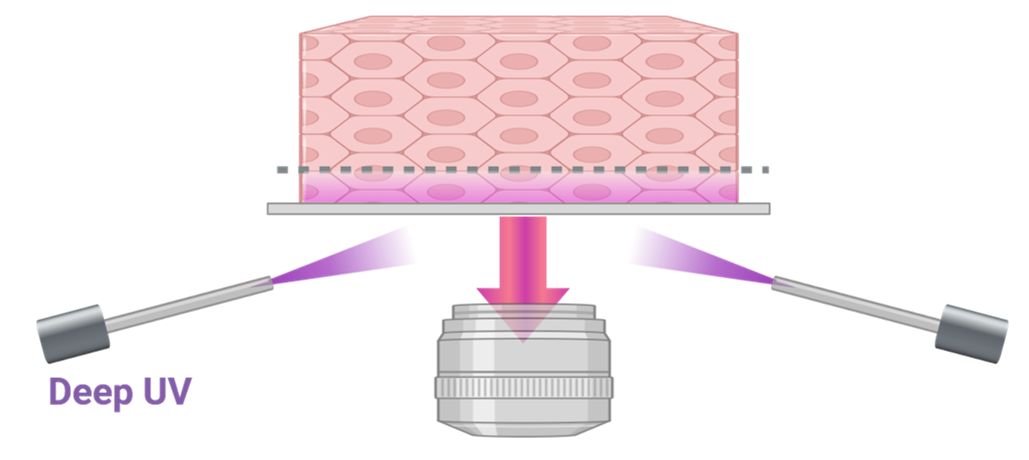
Our Deep UV Illuminator
A custom-built, deep UV LED array excites our probes. The arrays are hidden deep within OPAL, and the light is delivered through a set of fiber optic cables to the stage, using a patented opto-mechanical system to provide grazing illumination. The grazing illumination ensures that the UV light only shallowly penetrates the tissue. By keeping the depth of illumination less than the depth of field of the lens, we optically section the sample.
The LEDs are passively (and silently!) cooled, and are kept far away from the stage so that the sample is not damaged by heat. And because we don't use lasers, you don't need to worry about laser safety or licensing. Standard safety interlocks guarantee that the UV light source is perfectly safe to use anywhere from the office to the operating theater.
Our Probes
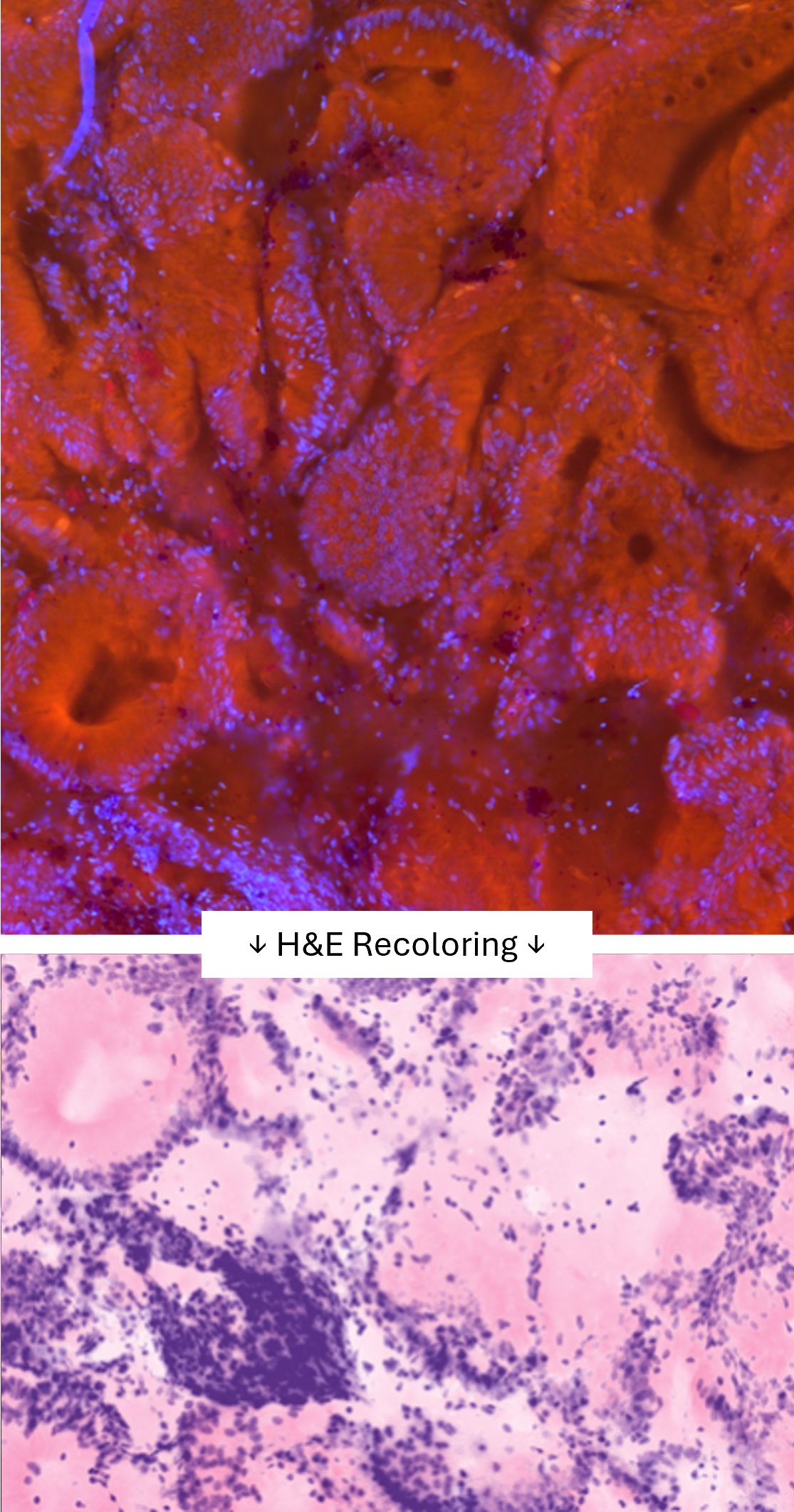
Images from our stains, alongside H&E recoloring. Image credit: Liang Kaicheng Lab
Our rapid stains provide effective nuclear and counter-staining in fresh tissue in minutes, producing gorgeous images, like the one shown on the right. These stains provide a clear contrast between the nucleus and the cytoplasm, allowing for easy interpretation.
If these images are unfamiliar to your pathologists, OPAL can digitally recolor these images to mimic the classic H&E stain. This recoloring is done in real-time, and can be toggled on and off at will. This allows pathologists to interpret images with minimal additional training.
And when you're done and ready to submit your tissue sample for the full FFPE? Our stains are water soluble and cleanly washed away when the sample is dehydrated.
Additionally, if you are searching for a specific disease, our cancer- and pathogen-specific assays work seamlessly with FUSE. We are currently developing immunohistochemistry dyes for specific markers, and are happy to work with customers to meet their needs.
Selected patents and publications
Our technology is protected by patents and disclosed in research papers.
-
A. S. K. Yong, N. Husna, K. H. Tan, G. Manek, R. Sim, et al., “Slide-free surface histology enables rapid colonic polyp interpretation across specialties and foundation AI,” medRxiv preprint, 2025.
Demonstrates that FUSE-based slide-free histology enables rapid interpretation of colonic polyps by clinicians across specialties and by foundation AI models.

-
G. M. Manek, A. S. K. Yong, and K. Liang, “Microscopy apparatus and method for superficial imaging of a sample,” Patent WO2025071477A1, 2025.
Patents the FUSE microscopy apparatus, including a fiber-optic surface illuminator and a low-cost, software-corrected stage for optical sectioning of fresh tissue.

-
A. S. K. Yong, K. H. Tan, S. Burhanudin, D. Xiong, W. Chang, et al., “Fiber-optic microscopy with ultraviolet surface excitation (FUSE) for endoscopy: opportunities and progress,” in Advanced Biomedical and Clinical Diagnostic and Surgical Guidance Systems XXIV, SPIE, 2025.
Explores the potential of adapting FUSE microscopy for endoscopic applications, bringing slide-free surface histology to in vivo clinical diagnostics.

-
J. L. Y. Ang, K. H. Tan, A. S. K. Yong, C. W. X. Tan, J. S. J. Kng, et al., “Multi-scale tissue fluorescence mapping with fiber optic ultraviolet excitation and generative modeling,” Optica, vol. 11, no. 5, pp. 673–688, 2024.
Introduces FUSE microscopy combined with a conditional normalizing flow (FUSE-Flow) for multi-scale tissue fluorescence imaging with real-time H&E-like recoloring.

-
J. L. Y. Ang, K. H. Tan, A. S. K. Yong, C. W. X. Tan, J. S. J. Kng, et al., “Multi-scale tissue fluorescence mapping with fibre optic ultraviolet excitation and generative modelling,” bioRxiv preprint, 2022.
Preprint of the Optica publication, describing the FUSE platform and generative recoloring model for real-time virtual histology.
